The demand for natural skin improvement is growing rapidly. More and more people want to not only reduce wrinkles or restore volume, but above all work on their skin quality: firmer, smoother, and fresher.

Whereas fillers and Botox used to be the only options available for looking younger, we are now seeing a clear shift: biostimulators have become an integral part of cosmetic medicine. Treatments such as Sculptra, PRP, and Radiesse are becoming increasingly popular.
But how exactly do these biostimulators work? And do they mean that fillers and Botox will soon become obsolete? In this article, we explain what biostimulators do, how they differ from each other, and how they work together with fillers and Botox.
Biostimulators stimulate the skin to improve itself. Instead of directly adding volume or relaxing muscles, they encourage the body to produce new building materials such as collagen and elastin. That is why we call them biostimulators:
They therefore work from within the skin itself. However, not every biostimulator does this in the same way. Below, we explain how three popular biostimulator treatments work.

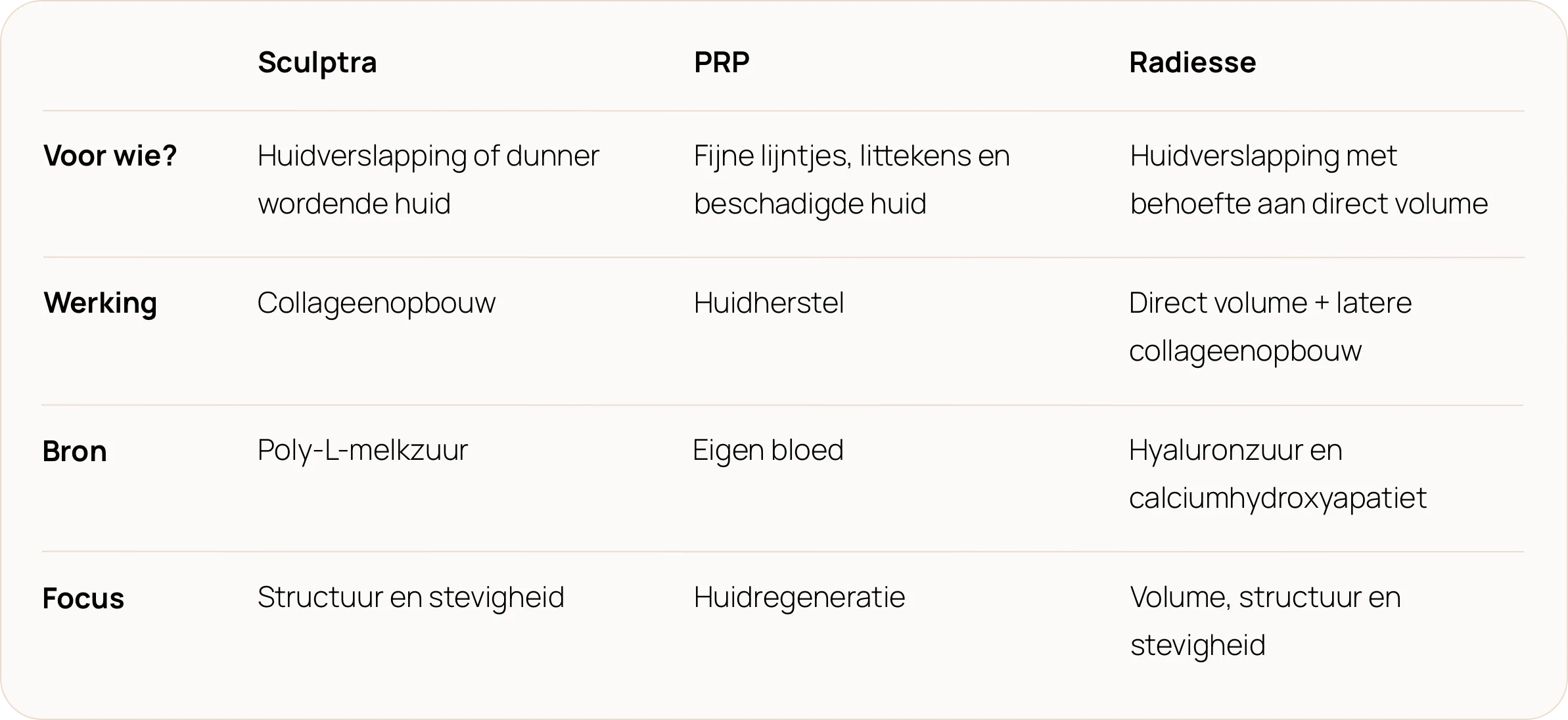
Sculptra contains poly-L-lactic acid, a substance that stimulates the body to produce new collagen. As we age, the concentration of collagen in the skin decreases. This causes the skin to become thinner and saggier. By increasing the concentration of collagen, Sculptra firms the skin from the deeper skin layers. Gradually, this results in a subtle lift of the sagging skin. For this reason, Sculptra is sometimes referred to as the "non-surgical facelift."
It therefore stimulates the body to rebuild its own structure. This can make the skin appear firmer and plumper, but it does not add direct volume like a filler does. The body's own collagen production takes time, which is why the results are usually only visible after 3-6 months. The results develop gradually and last for an average of 1.5 to 2 years.
Sculptra is suitable for:

PRP stands for Platelet Rich Plasma. During the treatment, a small amount of your own blood is taken and centrifuged. The platelets are filtered out, as these cells contain powerful growth factors.
These growth factors normally play a role in wound healing and tissue repair in your own body. Injecting these cells into the skin in high concentrations stimulates fibroblasts and cell renewal, which promotes skin repair. PRP therefore works not by adding volume, but by 'activating' the skin. Because PRP is completely natural to the body, it is one of the most natural forms of skin improvement.
PRP is particularly suitable for skin problems in the superficial skin layer, such as:
Then there is Radiesse: part biostimulator and part filler. Radiesse is therefore a treatment that both provides immediate volume and ensures long-term skin improvement.
Technically speaking, Radiesse contains two active ingredients: hyaluronic acid and calcium hydroxyapatite. Hyaluronic acid is the substance that fillers are made of. This provides immediate volume, just like a filler does. The second substance, calcium hydroxyapatite, is a biostimulator. These calcium particles occur naturally in the body and help the skin to produce collagen again in the long term. This gradually firms the skin and improves its quality. However, the degree of collagen stimulation with Radiesse is significantly lower than with Sculptra.
With the emergence of treatments such as Sculptra, PRP, and Radiesse, you may be wondering: are fillers and Botox now a thing of the past?
The short answer: no, biostimulators do not completely replace fillers and Botox. They serve a different purpose. Fillers and Botox mainly focus on shape, volume, and muscle activity, while biostimulators focus on skin quality, firmness, and elasticity. Often, the best approach is a combination of these treatments, tailored to your skin's needs and age. Curious about which biostimulator might be right for you? Discuss it with one of our cosmetic doctors during a no-obligation consultation.
Are these the only forms of biostimulation? Certainly not. Cosmetic medicine is constantly evolving, which means that new biostimulators are regularly being introduced and further scientifically substantiated.
In recent years, polynucleotides in particular have been rapidly gaining popularity. These substances are known for their regenerative and restorative properties: they support tissue repair, stimulate fibroblast activity, promote collagen and elastin production, and improve skin quality in terms of hydration, elasticity, and structure.
Would you like to learn more about this form of biostimulation? Keep an eye on our blog page: a comprehensive article about polynucleotides will be published soon!

.svg)
.svg)
.svg)

.svg)